

4-H Volunteers
4-H Volunteers
Youth-adult partnerships are an important component of 4-H. Volunteers can serve as role models, mentors, and advisors for 4-H youth, helping them to strengthen their leadership by taking active leadership roles working alongside volunteers and staff.
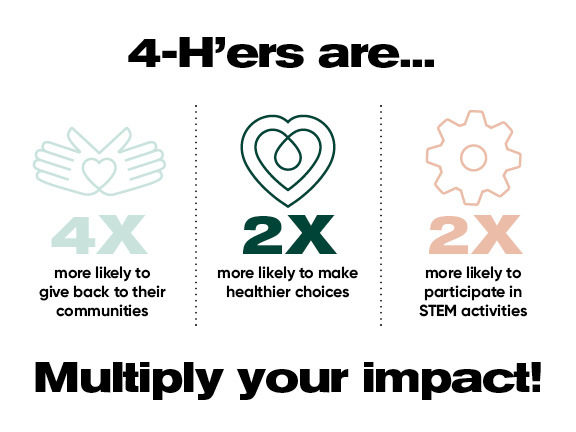
Youth involved in 4-H are 4x more likely to give back to their communities, 2x more likely to make healthier choices, and 2x more likely to participate in STEM activities! Through a variety of programs, 4-H’s unique hands-on approach gives kids the opportunity to learn by doing and build life skills.*
By working together in youth-adult partnerships, those who participate in 4-H become more connected and responsive to the needs of the community and gain new energy, perspective, and ideas.**
New Volunteers
Who can volunteer for 4-H?
Any adult 18+ who can pass a criminal history check and completes required training! You are not required to have children in 4-H in order to volunteer. We value the diversity of our volunteers and invite volunteers of all backgrounds to apply!
Accommodations are available for volunteers by request to the Extension office.
Please note: Trip chaperones must be 21+, and volunteers cannot be currently enrolled in high-school. Current high-school students who would like to pursue similar positions should enroll in 4-H and become junior leaders. Anyone interested in volunteering but under 18 should also enroll in 4-H and pursue student positions.
What are the roles of a 4-H volunteer?
Volunteers must be willing to amplify youth voices, create safe spaces, and support experiential learning programs. Beyond these overarching responsibilities, it is up to each volunteer to determine their role! Possibilities include: teaching activities, mentoring youth, leading groups, supporting programs, and chaperoning travel. If they would like, volunteers can further specialize their roles by choosing program areas to support. For more information on program areas, please visit: Projects – Wisconsin 4-H. In order to nurture youth-adult partnerships, it is helpful if volunteers consistently engage in 4-H, but one-time or event-only volunteers are also welcome. There will be volunteer opportunities shared on a regular basis, or volunteers can develop their own programs!
How do I become a 4-H volunteer?
*Enrollment for the 2026-27 year does not begin until September 15th*
Step 1: Enroll in 4HOnline: https://wi.4honline.com and agree to the Division of Extension Volunteer Behavior Expectations.
Step 2: Complete Criminal Background Check* (information will be sent via email to all new potential volunteers once a person has enrolled in 4HOnline, check for emails from HireRight)
Step 3: Complete Annual Required Volunteer Training.
Step 4: Complete any additional requirements if necessary for your selected roles.
Following the completion of all requirements, please contact the Extension Office for final approval.
*A background records check for arrest and conviction records will be completed every two years for continuing 4-H volunteer leaders.
Current Volunteers
Important Links
Volunteer Project & Program Basics
Interested in leading a 4‑H project or program? Awesome! Volunteers take the lead on planning and running their activity, with 4‑H Educators available for support and occasional check‑ins.
What you’ll do:
- Schedule a meeting space
- Plan your activities, goals, and schedule
- Make sure staffing and 4‑H guidelines are followed
- Request supplies at least two weeks ahead or purchase them yourself
- Create simple promotional info, including newsletter content
If you’re leading a project, you’ll also:
- Create a project guide and website info
- Meet at least once a month for a full year
Projects vs. Programs
Projects meet monthly for at least a year, focus on one topic that builds over time, and ask youth for longer-term commitment and work between meetings.
Programs are one‑time or short‑term events. Sessions stand alone, don’t require long‑term commitment, and can be broad or very specific.
Professional Development
Free Activity Libraries
If you have any questions, please email jerry.wilcenski@wisc.edu!